
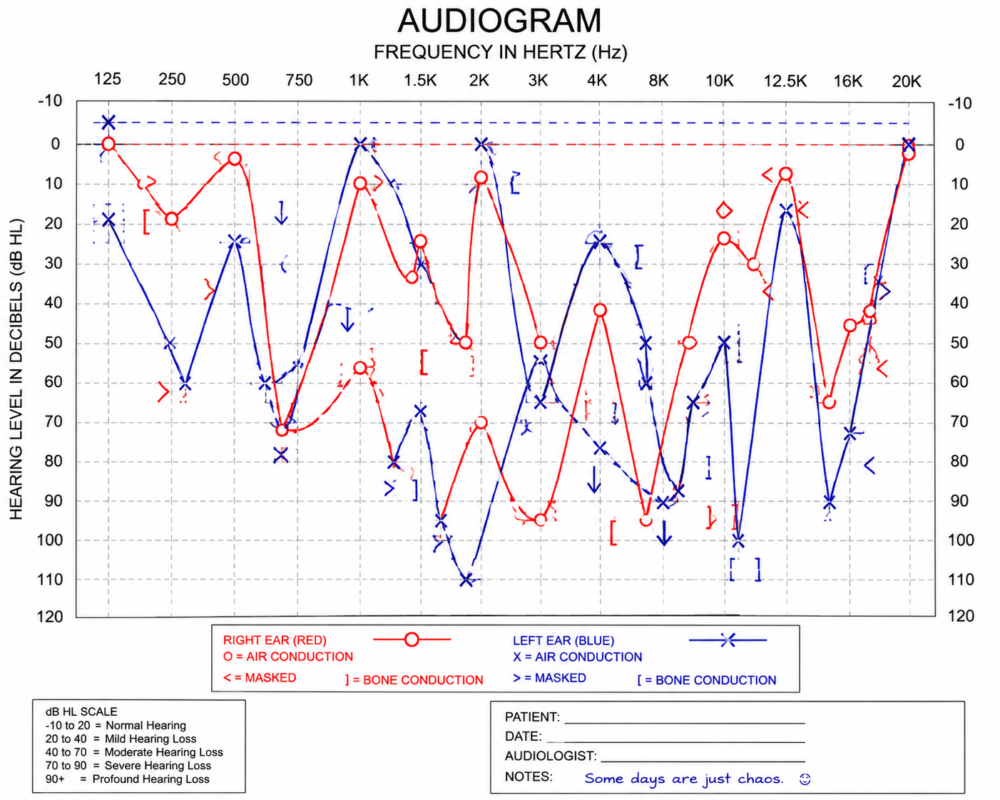
I went into this mapping appointment with one very specific complaint. I could hear…a lot. Actually, I was hearing more than I had in years. The problem was that everything still sounded muddy and boxy. Voices were too deep. My own voice sounded strange. Male voices were especially bad. Women were slowly beginning to sound more like women, but there was still something wrong with the overall balance.
I didn’t necessarily need more sound. I needed the sound I already had to make more sense. By this point, I had worked my way through all four programs on my processor and was already using the highest one. My cochlear implant had also quietly taken over as my primary source of sound. My right hearing aid, which had initially done most of the work after activation, had been demoted to more of a supporting role. The cochlear implant gave me sound. The hearing aid helped with some clarity.
So when I sat down for mapping, I had a pretty good idea of what I wanted to change. We increased the overall level slightly and adjusted both the lower and higher frequencies. Some of the lower tones were pulled in because so much of what I was hearing still lived in that deep, muddy, old-man-talking-in-a-box territory. And then Allyson spoke to me. Better. In fact, noticeably better. Then I spoke. I sounded better and that was huge. My own voice had been one of the strangest parts of learning to hear electrically. I know what I sound like. Or at least, I know what I should sound like. Hearing my own voice come back through my cochlear implant sounding deep and muffled was unsettling.
After the adjustments, I sounded more like me. Not exactly, but a bit closer. Things were still somewhat boxy, but considerably less so. We talked about the possibility that some of that remaining boxiness may simply need time. My brain is still learning. I’m also still relatively close to surgery, and residual fluid and inflammation can take weeks to resolve. If the boxiness is still hanging around later, we can tweak the map again. For the moment, though, things sounded better.
We decided to leave it alone. I left the office hopeful. And then I entered the real world. And as they say, “All good things must come to an end.”
My first clue came while ordering a drink at Jamba Juice. I could see the person taking my order talking to me. I could hear that she was talking. But actually hearing what she was saying? Not so much. That was strange. Then I got on the train. Now, the train has become one of my accidental cochlear implant benchmarks. Before this mapping appointment, it was loud through my CI. In fact, on the train to the appointment that morning, I had turned my processor volume way down because everything was too loud. On the train home? My CI volume was at 100%. Completely maxed out. And I was perfectly comfortable. Too comfortable. The entire train sounded like it had before when I intentionally turned my processor way down. Then we pulled into a stop and the overhead announcement came on. I could barely hear it. For a moment, I wondered whether the speaker in that particular train car was broken. So I turned on my right hearing aid. And there was the announcement. The speaker worked just fine.
Shit.
Once I got home, I started testing. Music. Videos. My phone speaker. The car stereo. Conversation. I kept turning things up. And up. And up. Until eventually everything was maxed. My cochlear implant was at 100%. My phone volume was at 100%. And the music wasn’t loud. It was soft and at a comfortable volume that wouldn’t disturb anyone. That’s lovely if that’s what I want. But what happens when it isn’t what I want? There was no more up and that became the problem.
I don’t want my cochlear implant programmed so that everything is permanently loud. I know how to turn the volume down. I had been doing exactly that on the train before the appointment. What I need is headroom. If something is too loud, I can turn it down. If something is too quiet, I need somewhere to go. At 100%, I had nowhere left to go. Then Aaron started talking to me at home. I could hear his voice. I knew he was speaking. But I couldn’t hear him very well at all. There is a very strange difference between those two things when you’re hard of hearing. Sound is there but the understanding isn’t. I started asking him to repeat himself. That was when this stopped being an interesting mapping observation and became a functional problem.
I have a job. I sit in meetings. I talk to people. I commute on trains. I listen to audiobooks. I use apps for auditory rehabilitation. I listen to music. I need to be able to hear ordinary human beings speaking to me without having every possible volume control pushed against its ceiling. The disappointing part is that the new map actually sounds better. Whitney Houston sounds better. My own voice sounds better. Allyson sounded better. Joe sounded better and Marina sounded more like the teen girl she is. Some of that awful boxiness is gone. So I don’t think the mapping appointment was a failure. And I don’t think anyone did anything wrong.
The map sounded genuinely good while I was sitting in a completely quiet audiology office. The problem was that the audiology office wasn’t Jamba Juice in the train station. It wasn’t the train. It wasn’t my house. It wasn’t Aaron talking to me from across the living room over the noise of the air conditioner and whatever song he had playing on his phone. It wasn’t an office meeting. And it wasn’t an audiobook playing from my phone.
The map that sounded good in the quiet audiology office simply didn’t translate into the amount of sound I needed once I walked back into my actual life. That may be one of the biggest things I’m learning about cochlear implant mapping. You can measure electrodes. You can establish comfortable levels. You can sit across from your audiologist and say, Yes. That sounds better. And mean it. Then you can walk outside and discover something completely different. Because hearing doesn’t happen in an audiology office. Hearing happens out here. In train stations, at work, at home, in restaurants, with kids talking from across the room, with music playing, with birds singing outside, with an overhead speaker announcing your stop while you’re trying to figure out whether the damn speaker is broken or whether it’s your cochlear implant.
And this is exactly why I recently sent MED-EL an idea for something I’d love to see added to the app. Give us a button, actually, give us two: + and −. Not buttons that immediately change the map. Buttons that let us flag a moment in real life when something sounds particularly good or particularly bad. If I’m sitting on the train thinking, This is way too loud, I tap the minus button. If I’m outside and suddenly realize I’m hearing birds beautifully, I tap the plus button. If someone’s voice sounds unusually clear, plus. If I’m struggling to understand someone who should be easily audible, minus.
The app could record what the processor was doing at that moment—program, volume, sensitivity, input source and whatever other processor information would be useful to the audiologist—along with the date and time. Maybe it could even let me add a quick note: Train. Too loud. Or Conversation. Perfect. Or Whitney Houston is a middle-aged man again.
Then, at my next mapping appointment, instead of trying to remember exactly what happened three weeks ago and describing it with highly technical audiological terms such as boxy, muddy, old man underwater and something is just weird, my audiologist would have actual information from the moments when I was living with the map. Because that’s the challenge. I can tell an audiologist what something sounds like while I’m sitting in her office. What I can’t do is bring the train, my living room, Jamba Juice, my coworkers, my kids, my stereo, my birds and Whitney Houston into the mapping room with me. But maybe someday, we can bring a little bit of the mapping room out here, where it really matters. We could preserve the moments when something works, or doesn’t, while we’re actually living life instead of depending on voice memos or illegibly scribbled notes we inevitably forget about on the way to the audiologist. Then the audiologist could see what was happening in those moments and have actual data to help pinpoint what worked and what didn’t. I don’t necessarily need to know why something sounds good or bad when I tap the button. That’s the point. I’m the one hearing it; my audiologist is the one who understands what all those processor settings mean. I just need a way to flag the moment so we can put those two pieces of information together later.
So, we’re not done with this map yet. I have another appointment on August 14 to figure out what happened to the volume and to talk about something else I’ve discovered: real-world sound and phone/streamed audio don’t seem to need the same settings. For now, my request is actually pretty simple: Give me today’s sound quality with yesterday’s volume. Then I’ll go away. Maybe. Probably not, though. I’m still the girl who demanded two hearing aids instead of one and who has endless amounts of questions about how to improve the hearing I have access to. So today’s sound is better, clearer and less boxy. And apparently, programmed perfectly for a library.

Comments