
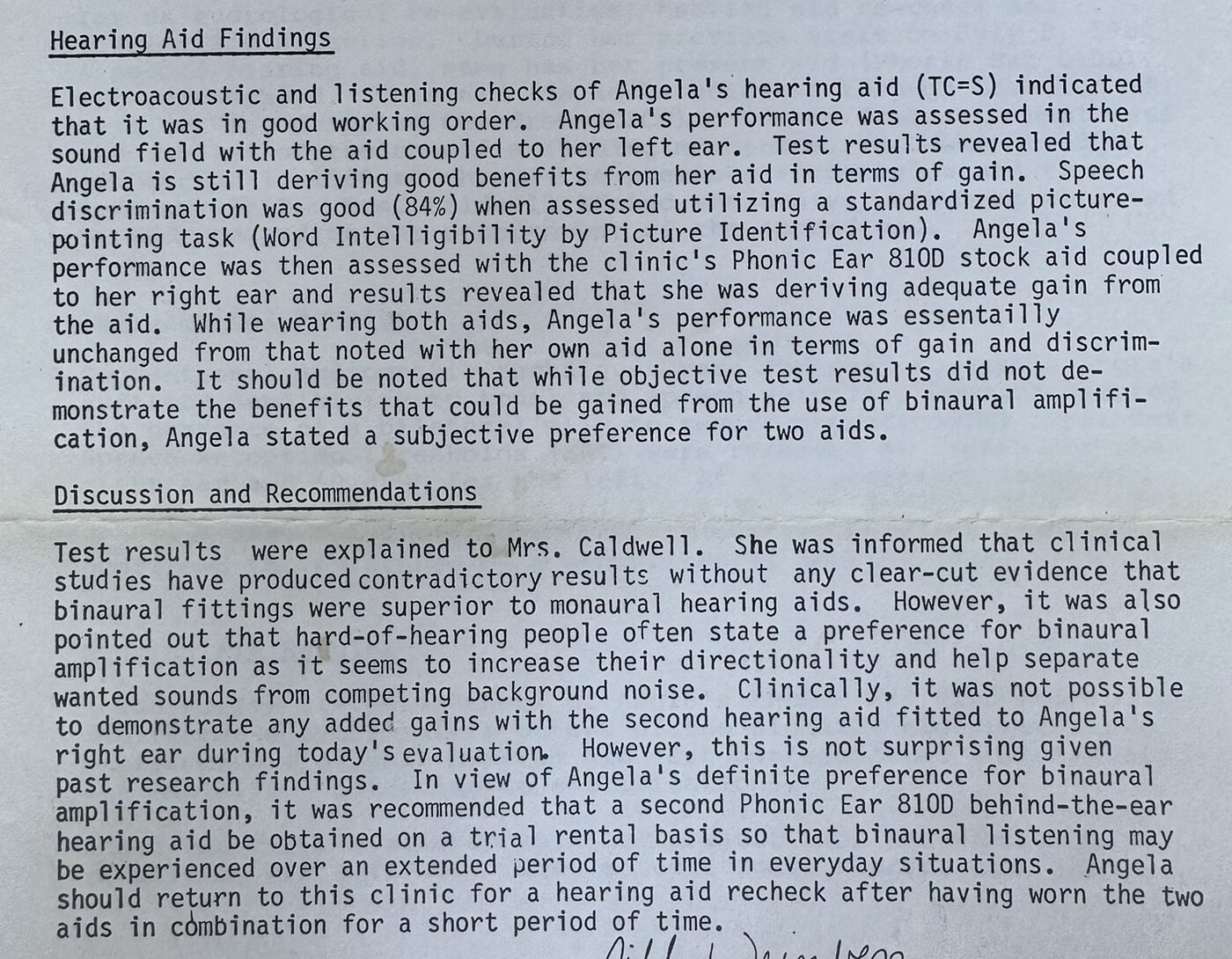
I have apparently always been demanding, which is not surprising in the least bit. One of my childhood audiology reports notes that I “insisted” on wearing two hearing aids, even though the testing, and the research available at the time, didn’t support it. I was five years old at the time.
I don’t remember making my case, but I can imagine it. Somewhere inside that tiny, stubborn little girl was the certainty that two ears were better than one, regardless of what the professionals or their research had to say about it. And as it turns out, I was right!
I was born with bilateral sensorineural hearing loss and began wearing hearing aids when I was around three years old. My brother also wore hearing aids, so hearing loss wasn’t unusual in our immediate family. Hearing aids were simply part of life. Something we put on in the morning so we could navigate a world built around sound.
But hearing aids could only amplify the sound that reached us. They couldn’t give us access to frequencies our ears were unable to hear.
One of my earliest memories is from speech therapy. I must have been three or four years old. I couldn’t hear the /s/ sound, so when I wanted to say “stop,” I said: “Top!”
I didn’t know anything was missing. How could I? You don’t know that a sound exists when you have never heard it. My speech therapist leaned toward me and carefully exaggerated the beginning of the word: “Sssssstoooop.” So, for a while, that was exactly how I said it.
Eventually, I learned to say “stop” naturally. I learned how to place my tongue, how the air should move and how the word should feel when I said it correctly. I learned to produce a sound I couldn’t actually hear.
That is how much of my childhood speech developed. Not entirely through listening, but through observation, repetition, muscle memory and a great deal of speech therapy.
I learned to function remarkably well with incomplete information. My brain filled in what my ears couldn’t provide, and most people never realized how much work was happening behind the scenes. Neither did I. For most of my life, hearing aids were enough to help me make sense of the world…or at least enough to let me believe I was hearing it.
Decades later, when my hearing aids could no longer give me clarity, that same stubborn little girl would ask another question: What’s next?

Comments